Life-history data
- Source of the laboratory stock
- Mission, Hidalgo County, Texas
- Adult laying medium
- Sand
- Early survival
- 25 of 460 eggs and larvae reached the second instar or beyond in the published series
Adults
Smith, Dornburg and Wheeler housed their wild-collected adults in plastic containers with sand. They kept different species, localities and collecting dates separate. I would follow that arrangement, especially with several similar-looking Eleodes in the collection. The researchers sifted each enclosure at intervals of one to two weeks and recovered both eggs and small larvae. Keeping the siftings from each date in a separate container gives a useful age window, even when individual eggs are hard to see.
Larvae
The young were raised in a mixture of sand and food. To maintain moisture the study used either daily watering or a plaster base supplied with water through a short tube. The latter establishes a gradient from the bottom up. I would keep one corner available for checking the damp layer and observe where the young settle. The study pooled its description of the rearing methods across several species, so it does not establish which watering method gave the best survival for this particular stock.
The published account followed 460 eggs and larvae from adults collected at Bentsen–Rio Grande Valley State Park. Only 25 reached the second instar or later. I would therefore count young again after their first molt before judging the success of a laying group. Late larvae have conspicuously darker dorsal plates on the eighth and ninth abdominal segments. These were useful in separating them from the other Eleodes larvae in the study. The illustrated descriptions were based on larvae in roughly their eighth through eleventh instars.
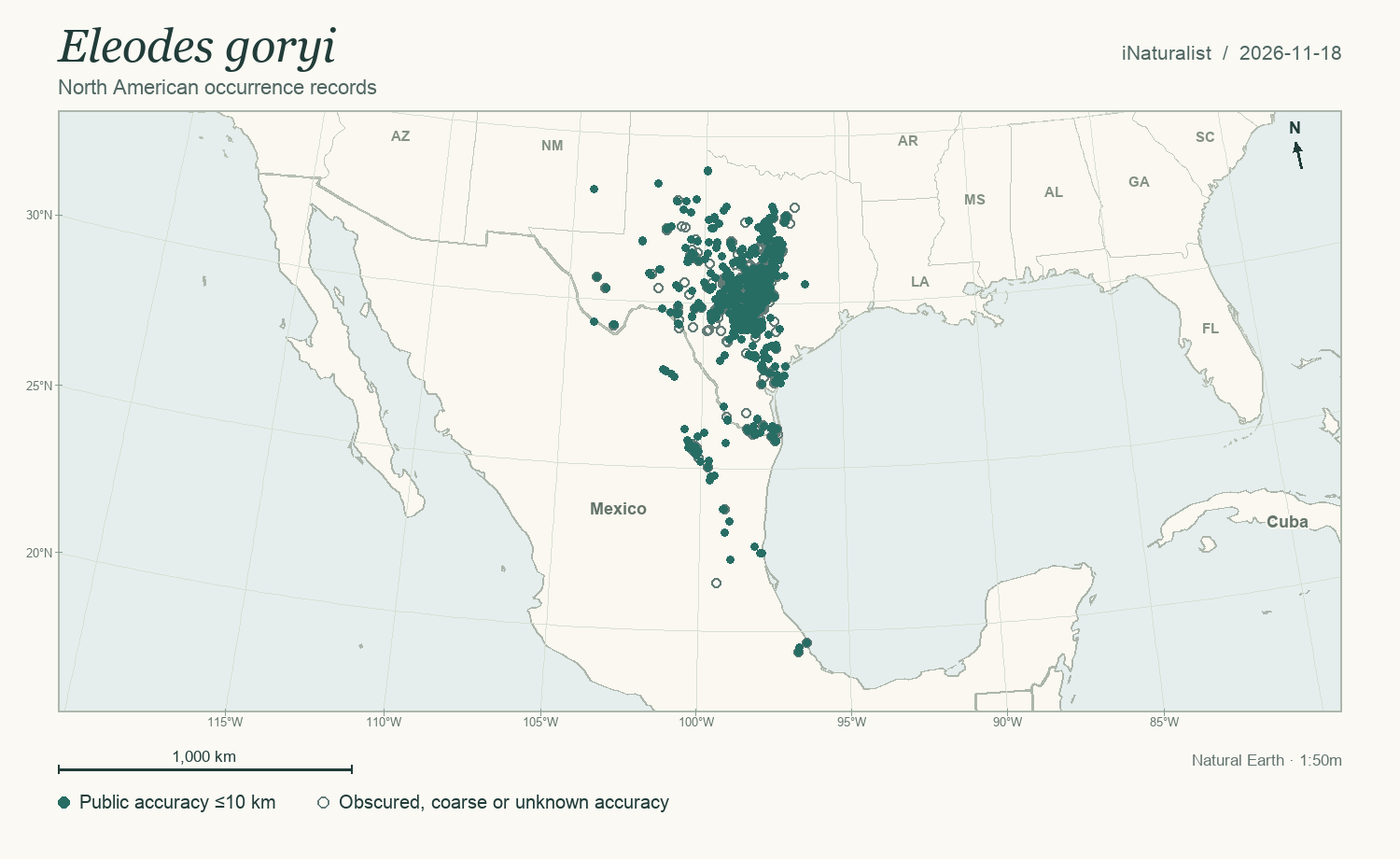
Distribution records